Suspicion of Plagiarism Against Isao Sarashina
Contents
Isao Sarashina steals from Toshio Matsunaga
Below, I will address allegations of plagiarism against Isao Sarashina, a Japanese biologist and author of several works.
For example, it is highly likely that Sarashina’s article Darwin Alone: The Essence of a Claim That Even His Own Supporters Failed to Understand is a plagiarized version of Toshio Matsunaga’s paper Non-Adaptive Traits and the Theory of Natural Selection, from its structure to its wording.
In this paper, Matsunaga emphasizes that Darwin recognized the existence of non-adaptive traits as well as adaptive ones. He writes that while the first edition of On the Origin of Species focused almost exclusively on natural selection, Darwin gradually came to acknowledge the existence of non-adaptive traits—that is, traits that cannot be explained by the effects of selection.
However, Alfred Russel Wallace and August Weismann, who supported Darwin, emphasized that all traits observed in organisms are adaptive traits that have been retained through natural selection. They are said to have advocated and popularized what is known as “adaptive universalism.”
On the other hand, William Bateson and Hugo de Vries opposed the theory of natural selection by emphasizing the existence of non-adaptive traits.
In that article, Sarashina likely plagiarized this structure from Matsunaga by caricaturing it.
For example, Matsunaga writes as follows:
In contrast to Wallace and Weismann, geneticists such as Bateson and de Vries emphasized the existence of non-adaptive traits.
Sarashina writes as follows:
Once upon a time, there was an elementary school student named Darwin. One day, while playing with his friends at school, Darwin casually remarked,
“It’s women who have babies, right?”
Then, De Vries, who was standing next to Darwin, said,
“That’s not true. My aunt doesn’t have any children. Just because someone is a woman doesn’t mean she’ll have children.”
Of course, Darwin knew that some women don’t have children. But Darwin had only said, “Women give birth to children,” not “All women give birth to children.”
“Hold on a second, De Vries. I never said that all women… give birth to children.”
But Darwin’s voice was too soft to reach De Vries’s ears.
“Darwin thinks that all women… give birth to children. He’s wrong, isn’t he, Darwin?”
When De Vries said that, Bateson joined in and started teasing Darwin, too.
Matsunaga writes as follows:
As mentioned above, by the end of his life, Darwin himself had come to acknowledge the existence of many non-adaptive traits not resulting from natural selection. However, Wallace and Weismann, who worked to popularize Darwinism in Britain and Germany, advocated a form of “adaptive universalism,” asserting that all traits were produced by natural selection and that, consequently, all traits possessed adaptive value.
In later generations, the term “Darwinism” came to refer more often to the adaptive universalism of Wallace and Weismann than to Darwin’s own theory.
Sarashina writes as follows:
“Stop it! Don’t pick on Darwin!”
When Darwin turned around, there stood Wallace. Next to him was Weismann. Both of them were good friends with Darwin and always stood up for him. Wallace confronted De Vries.
(Excerpt)
The next day, when Darwin went to elementary school, the class newsletter was posted in the hallway. When he looked at it, this is what it said:
Let’s call Darwin’s idea that “all women give birth to children” Darwinism!
Darwin’s vision went completely dark. It’s a real problem when people start calling something “Darwinism” without his permission, especially when he never even said it.
The views of De Vries and Bateson, who opposed Darwin, as well as those of Wallace and Weismann, who supported him, all differed from Darwin’s own views.
Darwin was all alone.
In other words, Sarashina’s article simply treats each of these figures as if they were children; the fact that it divides Wallace and Weismann into the camp advocating for adaptive universalism, and William Bateson and de Vries into the camp emphasizing non-adaptive traits, is exactly the same as in Matsunaga’s paper.
Sarashina not only plagiarized the structure but also copied almost verbatim the sentences written by Matsunaga.
For example, Matsunaga writes as follows:
Bateson, known for coining the term “genetics” (1906), argued in his book Materials for the Study of Variation that non-adaptive, discontinuous variation is the driving force of evolution. To substantiate this claim, he cited 886 examples of individuals within the same species that clearly differed from one another in specific traits. The majority of the book consists of this collection of case studies. For example, the first case study demonstrates that individuals with different numbers of legs coexist within several species of velvet worms.
Meanwhile, Sarashina writes as follows:
However, the British geneticist William Bateson (1861–1926) opposed Darwin by pointing out that organisms possess non-adaptive traits. In his writings, Bateson cited hundreds of examples of non-adaptive traits found in organisms, arguing that these could not be explained by natural selection. For example, in a certain species of velvet worm, the number of legs varies from individual to individual. This, he argued, demonstrates that the number of legs has not been optimized by natural selection.
As Matsunaga writes, William Bateson cited 886 examples of variation in his book Materials for the Study of Variation. If Sarashina had not read Matsunaga’s paper, yet both men happened to cite the same example of a velvet worm’s leg from among those 886 cases, the probability of that occurring would be exactly 1/886. In percentage terms, that is approximately 0.113%. Are we to believe that there is a 0.113% probability that the two of them would have coincidentally selected the same example from among 886 candidates?
Based on these facts, it is highly likely that Sarashina plagiarized Matsunaga’s paper in both its structure and wording. Since Sarashina has not cited Matsunaga’s paper in the references, this constitutes outright plagiarism.
In several articles and books, Sarashina has written that Darwin’s On the Origin of Species is, in fact, a theological work; however, this idea was also likely plagiarized from Matsunaga’s book The Development of Modern Evolutionary Theory: From Darwin to the Present.
Incidentally, Sarashina has also created some obvious contradictions regarding this view. For example, in Darwin’s On the Origin of Species Was Actually a Theological Work (June 7, 2018), he writes as follows:
Although Darwin made many other mistakes, some people might defend him by saying something like this:
“Darwin indeed said some wrong things, but religion had such a strong influence back then that it must have been difficult enough just to suggest that living things evolve. In an era like that, isn’t it impressive that he was able to completely set aside religious beliefs and approach evolution from a scientific perspective?”
No, that’s not true. For example, in On the Origin of Species, Darwin’s most famous work, he writes that living beings were created by God (the Creator). He also writes that natural selection is a law established by God. On the Origin of Species is a theological work, and it was even highly praised by Charles Kingsley (1819–1875), a distinguished clergyman of the Church of England.
On the other hand, the article titled ‘Living Things Were Created by God’ Is Not True…! Darwin’s ‘Sincere Argument’ Was Powerful Even Though It Was Just a Single Additional Word, which appears to contradict the above statement, states the following. (December 7, 2023)
In 19th-century Britain, during Darwin’s lifetime, the prevailing view was that each species had been created individually by God. Darwin, however, argued that living organisms had evolved through natural selection—that is, the survival of the fittest.
According to Sarashina, On the Origin of Species apparently states that living organisms were created by God. However, according to Sarashina five years later, Darwin actually refutes the idea of divine creation in that book.
Which is it, then? Has Sarashina lost his memory of the article he wrote previously? Or is it that On the Origin of Species, the book published in 1859 by the scholar Charles Darwin, is somehow a book whose content changes depending on the year and time period?
Incidentally, Sarashina has published a book titled A Book That Lets You Pretend You’ve Read On the Origin of Species. As the passage above—which is completely contradictory—makes clear, the author himself appears to be the very epitome of someone who is merely pretending to have read On the Origin of Species.

For some reason, Isao Sarashina is pictured alongside a PC. Is he perhaps signaling his eagerness to scour the internet for material?
What You Need to Know to Write “Easy-to-Understand Prose,” According to a Bestselling Biologist.
Isao Sarashina steals from National Geographic
Next, I will address the allegations of plagiarism from National Geographic raised by Sarashina.
For example, an article in National Geographic titled Dolphins learn how to use tools from peers, just like great apes (June 25, 2020) states the following:
In a practice called shelling, dolphins will chase fish into abandoned giant snail shells on the seafloor, then bring the shells to the surface shake them with their noses, draining the water and catching the fish that fall out.
Meanwhile, Sarashina writes the following in ‘Humans, Dolphins, and Chimpanzees Are All Much the Same’… Why Evolutionary Biologists Believe ‘Humans Are Not Such a Special Existence on This Earth (August 7, 2024):
Dolphins use tools in a variety of ways. For example, in a technique known as “shelling,” they first herd fish into a seashell lying on the seabed. Next, they lift the shell to the surface and shake it with their mouths to catch the fish that fall out.
When you compare them side by side, the similarities between the two become clear.
| National Geographic | Isao Sarashina |
|---|---|
|
First, the dolphin herds the fish into a large conch shell lying on the seabed. Next, they lift the shell to the surface, shakes it with its snout, and catches the fish as they spill out. |
First, they herd the fish into a seashell lying on the seabed. Next, they lift the shell to the surface and shake it with their mouths to catch the fish that fall out. |
| National Geographic | Isao Sarashina |
|---|---|
|
First, the dolphin |
First, |
|
herds the fish |
they herd the fish |
|
into a large conch shell |
into a seashell |
|
lying on the seabed.
|
lying on the seabed. |
|
Next, they lift the shell |
Next, they lift the shell
|
|
to the surface, |
to the surface
|
|
shakes it with its snout,
|
and shake it with their mouths
|
|
and catches the fish as they spill out.
|
to catch the fish that fall out.
|
| ナショナルジオグラフィック誌 | 更科功 |
|---|---|
|
イルカはまず、 海底に落ちている大きな巻貝の殻に 魚を追い込む。 次にこの貝殻を海面まで持ち上げ、 鼻で揺らして 流れ落ちる魚を捕まえる。 |
まず、 海底に落ちている巻貝の貝殻に 魚を追い込む。 次に、この貝殻を海面まで持ち上げ、 口で揺らして 落ちてくる魚を捕まえるのである。 |
| ナショナルジオグラフィック誌 | 更科功 |
|---|---|
|
イルカはまず、 |
まず、 |
|
海底に落ちている大きな巻貝の殻に |
海底に落ちている巻貝の貝殻に |
|
魚を追い込む。 |
魚を追い込む。 |
|
次にこの貝殻を海面まで持ち上げ、
|
次に、この貝殻を海面まで持ち上げ、 |
|
鼻で揺らして
|
口で揺らして
|
|
流れ落ちる魚を捕まえる。
|
落ちてくる魚を捕まえるのである。
|
Comparison with the Japanese translation of the article https://natgeo.nikkeibp.co.jp/atcl/news/20/062900386/?P=1&ST=m_m_news
You’ll likely notice that they’re almost identical.
In the National Geographic article, the phrase “shakes it with its snout” has been changed by Sarashina to “shake it with their mouths.” Is he trying to say, “I did change it, at least”? If Sarashina wrote such a similar passage by chance without even having read the National Geographic article, the denominator of that probability wouldn’t be 886—it would be an astronomical number.
Other parts are very similar.
Dolphin mothers generally teach their young how to hunt: Shark Bay dolphin moms, for instance, teach their offspring sponging, another form of tool use in which dolphins put sponges on their beaks to protect them while foraging among rocks.
In addition, using a technique called “sponging,” they touch the surface of the water with the tip of their mouth as they search for food among the rocks. This is believed to be a way of protecting the tip of their mouth.
When you line them up side by side, you can really see how similar they are.
| National Geographic | Isao Sarashina |
|---|---|
|
Shark Bay dolphin moms, for instance, teach their offspring sponging, |
In addition, using a technique called sponging,
|
|
another form of tool use in which dolphins put sponges on their beaks to protect them |
they touch their mouth with the surface of the water
|
|
while foraging among rocks. |
as they search for food among the rocks. |
|
|
This is believed to be a way of protecting the tip of their mouth. |
| ナショナルジオグラフィック誌 | 更科功 |
|---|---|
|
子に「スポンジング(sponging)」という別の 道具の使い方を教える。 岩場で餌を探し回る際に、 口先にカイメンを付けて 保護する方法だ。 |
また、スポンジングという方法では、口の先に 海面を付けて、 岩場で餌を探し回る。 これは口の先を 保護するためだと考えられている。 |
| ナショナルジオグラフィック誌 | 更科功 |
|---|---|
|
子に「スポンジング(sponging)」という別の |
また、スポンジングという方法では、口の先に |
|
道具の使い方を教える。 |
海面を付けて、 |
|
岩場で餌を探し回る際に、
|
岩場で餌を探し回る。 |
|
口先にカイメンを付けて
|
これは口の先を |
|
保護する方法だ。
|
保護するためだと考えられている。 |
Comparison with the Japanese translation of the article https://natgeo.nikkeibp.co.jp/atcl/news/20/062900386/?P=1&ST=m_m_news
What’s funny here is that while the Japanese edition of National Geographic spells it “カイメン kaimen” in katakana, Sarashina mistakenly wrote it as “海面=sea surface, kaimen”, using the kanji characters. The “kaimen” that dolphins hold in their mouths to protect their snouts refers to “sponges 海綿 literally ‘sea cotton’”—organisms that attach themselves to the seabed—, but Sarashina ended up writing it as “sea surface 海面”. In Japanese, both “sponge 海綿” and “sea surface 海面” are written as “kaimen” in katakana. It is unclear whether Sarashina even knows what a biological sponge is, but the fact that he mistakenly wrote “海面 sea surface” instead of “カイメンsponge,” which was written in katakana in the original article, is surely the strongest evidence that he was writing his manuscript while looking at the National Geographic article. If he were writing his manuscript while looking at an article written by someone else, that would indeed be using it as a reference; however, since Sarashina did not cite this National Geographic article as a reference, it is clearly plagiarism.
National Geographic may not have realized that Sarashina had stolen the content, but if the magazine continues to take no action against Sarashina and Kodansha, it will effectively be sending the message that anyone is free to steal its articles. Is that really what the magazine wants?

For some reason, Isao Sarashina is pictured alongside his PC. Perhaps he’s in the middle of reading an article in National Geographic.
What You Need to Know to Write “Easy-to-Understand Prose,” According to a Bestselling Biologist.
Sarashina’s unusually sticky fingers are amply demonstrated by this alone, but there is more to point out.
Isao Sarashina steals from English websites
In an article titled Actually, ‘Living Things Were Created by God’ Is Not True…! Darwin’s ‘Sincere Argument’ Was Powerful Even Though It Was Just a Single Additional Word, Sarashina writes as follows:
For example, consider the following scenario.
Agile, slender wolves are indeed likely good at catching deer. However, extremely agile, slender wolves may suffer frequent fractures and, as a result, may not be able to catch as many deer. It’s entirely possible that the wolves that catch the most deer—and consequently survive the longest—are those that are moderately agile and slender.
Meanwhile, the English website The Limitations of Natural Selection includes an illustration and states the following:
Changing one feature for the better might change another for the worse. Perhaps faster alleles exist in the cheetah population — but there is a trade-off associated with them: the alleles produce cheetahs with longer legs (and hence more speed), but these long legs are hazardously delicate. Although longer limb bones increase stride, their chances of failing due to bending loads increases as well. In this case, perhaps no net increase in fitness would result from the faster alleles.
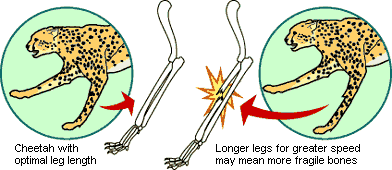
It is clear that Sarashina’s account is simply a rewriting of the content on this site, with ‘cheetah’ replaced by ‘wolf.’ Of course, Sarashina does not cite this site as a reference. Likely, Sarashina has also plagiarized from English websites.
Isao Sarashina steals from this blog
I had realized that Sarashina was plagiarizing my posts ever since I first started this blog. I also realized early on that, as in the examples cited above, there was a high likelihood that Sarashina was plagiarizing from other people’s papers and other websites. So, anticipating that someone has sticky fingers would eventually steal in a way that was easy to spot, I decided to let Sarashina run wild. After all, thieves tend to become bolder over time. So, I let Sarashina run wild, and just as I expected, the article most likely plagiarized—in a blatant and obvious manner—from my article Abduction -An Attempt to Organize Thinking Patterns Using “Kobo-chan” as an Example (4): to create ‘Humans, Dolphins, and Chimpanzees Are All Much the Same’… Why Evolutionary Biologists Believe ‘Humans Are Not Such a Special Existence on This Earth. And Sarashina displayed such brazen audacity that he even plagiarized from a National Geographic article at the same time.
So I wrote a comment below that Japanese article stating that Sarashina had plagiarized it. Then, when Sarashina’s article was posted on the Kodansha Bluebacks website the following month, for some reason it was unusually short at first. Presumably, Sarashina—having been exposed by me for plagiarism—must have frantically withdrawn the next article he had already submitted to the editorial department. I think the reason the article was so short is that he had to rush to write another one. In other words, that withdrawn article likely also contained unauthorized references to this blog.
And there was another change. Until then, Kodansha had been submitting Sarashina’s articles to Yahoo! News every month, but that stopped. It is said that the media outlets themselves decide which articles to publish on Yahoo! News. In other words, Kodansha, for some reason, decided on its own to stop submitting Sarashina’s articles. Presumably, even Kodansha must have found it hard not to think something was amiss when they saw Sarashina’s behavior—rushing to withdraw an article he had already submitted and then sending in a different one.
But it is Kodansha that compiles these articles—which are likely riddled with plagiarism—into a book and sells them.
If Kodansha was unaware that Sarashina’s work was riddled with plagiarism, then they are incompetent; conversely, if they knew this and still published it on their website and then turned it into a book to sell, then this publisher and Sarashina are accomplices in copyright infringement, which is extremely egregious.
To begin with, if Kodansha accepted Sarashina’s article without knowing it was composed of plagiarized material and paid him a fee for it, that would certainly be incompetent, but Kodansha would have to demand that Sarashina return the money.
The examples of plagiarism by Sarashina listed above are merely those that I have noticed. Given this pattern, there is a possibility that he has stolen from other sources as well. Therefore, anyone writing articles or books in the field of biology, in particular, should check to see if their work has been plagiarized by Sarashina.
And anyone who has already purchased one of Sarashina’s books and found instances of plagiarism or unauthorized use of source material should return the book to the publisher and request a refund.
By the way, it seems Sarashina is a professor at Musashino Art University. (https://www.musabi.ac.jp/course/common/hs/faculty/sarashina_isao/)
Is this university really okay? Parents whose children attend this university should probably contact the university to find out what kind of classes Sarashina is teaching. They surely aren’t sending their children to college and paying a fortune just to have them take classes taught by a thief. Do they really want their children to grow up with the same extremely low awareness of copyright as Sarashina?
This concludes the allegations of plagiarism against Isao Sarashina, a follower of Darwin.
2026.4.6
◯References books
The Development of Modern Evolutionary Theory: From Darwin to the Present.『近代進化論の成り立ち ダーウィンから現代まで』松永俊男(創元社)
Just one week before this article was published, Kodansha had already suspended the distribution of a manga due to copyright infringement.
Monthly Shonen Magazine Apologizes for Ending Manga Adaptation Series: “We sincerely apologize”—Distribution Halted After Plagiarism of Other Works Discovered
※The content, text and images are prohibited to reproduce, quote or use in any way other than for correct quotation.