Suspicion of Plagiarism Against Satoshi Chiba:
Or, The Downfall of the Man Who Wiped Out Chichijima’s Endemic Snails
Contents
Satoshi Chiba, who caused the extinction of a snail endemic to Chichijima through failed pest control efforts
I would like to address the allegations of plagiarism against evolutionary ecologist Satoshi Chiba, but in Chiba’s case, there is something that needs to be addressed before I even get to the issue of plagiarism. The reason is that Chiba is the man who failed at pest control and caused the extinction of an endemic snail species inhabiting Chichijima, one of the Ogasawara Islands. Furthermore, Chiba is not only the man who caused the extinction of that endemic snail, but also the man who, despite having numerous opportunities to write about the endemic snails of the Ogasawara Islands and their extinction in his books, continued to conceal the fact that his own missteps were the cause.
Chichijima, one of the Ogasawara Islands
According to Chiba’s book Invited Natural Enemies: The Dreams and Traps Created by Biodiversity, written nine years after the species’ extinction was confirmed, it was discovered in the 1990s that the New Guinea flatworm Platydemus manokwari—a species of planarian introduced from elsewhere—was inhabiting Chichijima, one of the Ogasawara Islands, and had begun preying on the island’s endemic snail, the Katamaimai Mandarina mandarina.
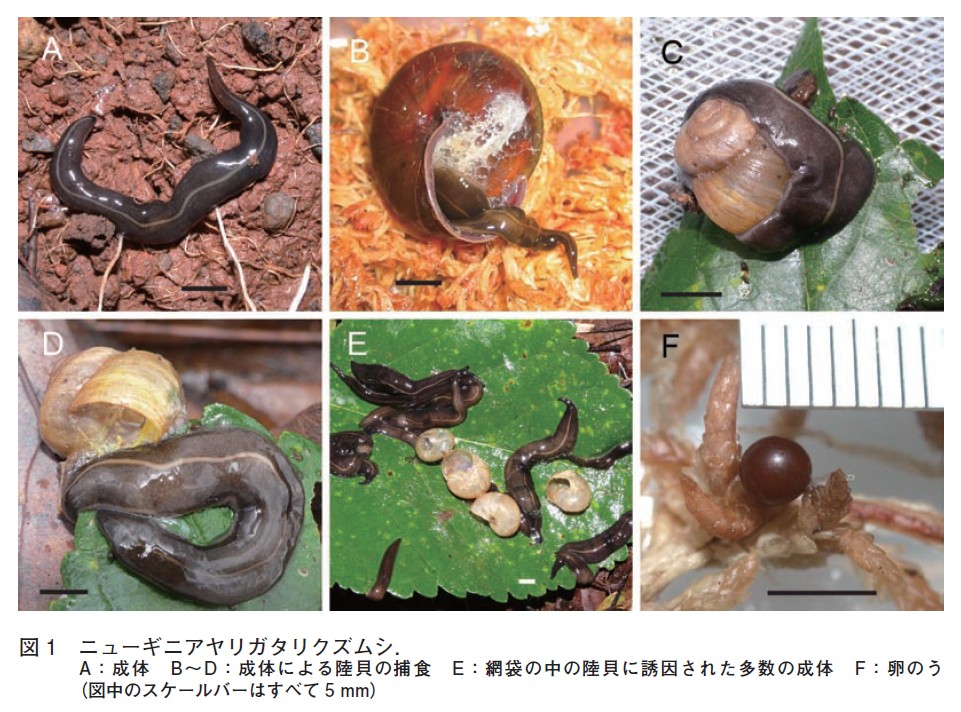
The New Guinea flatworm feeding on snails in the Ogasawara Islands.
From Impacts of the invasive flatworm Platydemus manokwari on island-endemic land snails
Shinji Sugiura
It is said that entomologists Isamu Ōkouchi and Takashi Ōbayashi began their research and, predicting that the land snails of Chichijima would face extinction if left unchecked, initiated efforts to develop control measures. Ōkouchi, anticipating the possibility of extinction in the wild, believed it was necessary to establish a captive breeding program. Consequently, Ōkouchi and Ōbayashi reportedly asked Chiba, a malacologist, to develop the necessary breeding techniques.
However, Chiba did not agree. He argued that the conservation value of the Mandarina mandarina lies in its unique evolutionary history, and that successful artificial breeding would require capturing large numbers of individuals from the wild—a practice that could potentially accelerate the extinction of wild populations.
I hadn’t realized that the New Guinea flatworm was such a serious problem. Rosy wolfsnail, once feared as the world’s most dangerous, has caused almost no harm to native snail species in the Ogasawara Islands. Perhaps the Ogasawara species are highly fertile, or perhaps, unlike tropical regions such as Guam, the damage doesn’t spread as widely in the cooler climate of the Ogasawara Islands.
From Invited Natural Enemies: The Dreams and Traps Created by Biodiversity
Or he writes this as well:
In response to my argument that “starting preparations for artificial breeding when there is a prospect of successfully controlling the flatworm amounts to a form of defeatism and hinders our ability to focus our efforts on controlling them,” “it will result in wasted expenses, time, and manpower for research into rearing methods and breeding programs,” and “we cannot ignore the risk of driving the wild population to extinction through capture for artificial breeding,” Ōkouchi countered as follows.
“Establishing an eradication method promptly and successfully eliminating the flatworm —this is the best course of action and should be our primary goal. However, there is a possibility that the work will not proceed as planned, and the effort may fail. Therefore, we will establish a defense line to curb the spread of the flatworm. If this works, even if the eradication fails, we can buy time to refine our methods until we succeed in the future. It would be ideal if this plan works, but unfortunately, we might not finish building the defense line in time, or the line we’ve built might be breached. In that case, Mandarina mandarina on Chichijima could be wiped out entirely. What should we do if all defensive measures fail? Even if the probability is low, we must prepare now for the worst-case scenario.”
He argues that the binary opposition of winning or losing is not a good approach. He says that rather than risk losing everything if we fail, we should ensure that even if we do fail, there are still possibilities for the future.
From Invited Natural Enemies: The Dreams and Traps Created by Biodiversity
Subsequently, the Ministry of the Environment launched a project to control the New Guinea flatworm, and Chiba reportedly participated in this research and project alongside Ōkouchi and others.
It gradually became clear that this New Guinea flatworm was far more difficult to deal with than Chiba had initially anticipated—it feeds on organisms other than snails, and because it remains underground during the day, it cannot be effectively killed using various chemicals.
Although the idea of creating and releasing artificially sterilized flatworms was considered, it was deemed impractical given the necessary facilities and costs involved.
In the end, the only feasible option was to build a “protective barrier” to safeguard the remaining Mandarina mandarina—a highly physical approach.
Although Chiba had initially been opposed to artificial breeding, he eventually had no choice but to take it on. Chiba reportedly believed that since the ecology of the Mandarina mandarina was well understood, breeding them would not be difficult. However, when he actually tried raising them, they were reluctant to lay eggs. So, he entrusted the task to Hideaki Mori, a graduate student whose hobby was animal care, and the snails began laying eggs. Mori then developed a manual for breeding the Mandarina mandarina, and through his efforts—recognizing that the cooperation and understanding of the residents were essential—the breeding of these snails is now carried out by the islanders themselves.
It is reported that protective barriers designed to electrocute and kill the invading flatworms were installed across the island along four lines—from the first to the final line—in accordance with Chiba’s proposal. The barriers were designed to withstand typhoons, and solar panels were installed to power them.
However, due to construction delays and other factors, the flatworms reportedly breached the defensive lines one after another.
Then, in 2014, the flatworm had taken over nearly the entire island of Chichijima—except for the peninsulas at its southern and southeastern tips—and had wiped out all the Mandarina mandarina that had lived there. The extinction of the Mandarina mandarina and Mandarina suenoae that had been found in the eastern part of Chichijima was virtually confirmed.
From Invited Natural Enemies: The Dreams and Traps Created by Biodiversity
Chiba writes that he takes responsibility for the extinction of the Mandarina mandarina in the wild.
Rather, I believe the actual responsibility lies with me—as an expert on the conservation targets—for having provided advice and recommendations throughout the process, from decision-making to planning and implementation, within the subcommittee of the Ministry of the Environment tasked with carrying out the measures.
Therefore, I would like to analyze and document the reasons for this failure here.
First, as with many of the failure cases discussed in this book, the problem lies in a lack of knowledge. Until the 1990s, there was only one expert in Japan capable of accurately classifying and identifying terrestrial flatworms. Unlike insects, for which a vast body of basic research has been accumulated, there is virtually no basic research on terrestrial flatworms due to their limited relevance to human life. Because there was no accumulation of “optional value”—that is, countless basic research studies whose practical applications were unclear—there was a severe lack of reference knowledge when the need for control measures actually arose. Consequently, the development of eradication methods for the New Guinea flatworm proved to be a difficult process.
Second, I initially underestimated the risks. My experience with the Rosy wolfsnail, which was considered low-risk in the Ogasawara Islands, and the theoretical prediction that prey species would not go extinct did not apply to the invasion of the flatworm. Because I failed to recognize the flatworm’s resilience in the early stages, I was slow to propose the establishment of a defense line. Furthermore, my analysis that the plan would proceed as expected was also incorrect.
From Invited Natural Enemies: The Dreams and Traps Created by Biodiversity
Satoshi Chiba, who published three books on snails endemic to the Ogasawara Islands while concealing the fact that their extinction in 2014 was the result of his own missteps
On the surface, this passage seems to indicate a candid admission that, while efforts were made to protect the endemic snail from New Guinea flatworms, they ultimately failed. However, this was written in a book published in 2023—nine years after the species’ extinction had been confirmed.
Other books Chiba published during those nine years include:
Full-Color Natural Science Manga: The Snail Goes to Ogasawara (Fukonkan Shoten), 2015
The Singing Snail: A Story of Evolution and Spirals (Iwanami Shoten), 2017
The Mechanics of Evolution: Stories of Modern-Day Darwins (Kodansha), 2020

The books Chiba wrote during the nine years between the confirmation of the extinction of the Mandarina mandarina on Chichijima and the publication of Invited Natural Enemies. Not a single word in these books mentions the fact that he caused their extinction through his own missteps.
What is puzzling about Chiba is that, while these books do mention the endemic snails of the Ogasawara Islands and their extinction, they do not say a single word about the fact that this extinction was due to Chiba’s own missteps.
In other words, the three books mentioned above were written by a person who must have known that pest control efforts had failed due to his own missteps, and that the Mandarina mandarina no longer exists in the wild on Chichijima.
Why did Chiba fail to mention for nine years the fact that his own missteps had driven Chichijima’s endemic snails to extinction?
And did the publisher of the aforementioned book know about this fact from Chiba? If they knew about it but still did not allow him to write it, then Chiba and the publisher would be in a kind of collusive relationship. Conversely, if they were not informed, then Chiba would have been deceiving both the publisher and the readers. Incidentally, it is telling that the book in question, Invited Natural Enemies, was published by Misuzu Shobo, which is different from any of the publishers that released the three books mentioned above.
The baffling tendency to criticize methods he himself “did not adopt.”
What is also puzzling is that, in that book Invited Natural Enemies, Chiba writes at length to criticize the history of biological control as a response to chemical control—and how it was a series of failures—yet Chiba himself did not even consider implementing biological control on Chichijima.
And one final point: we did not necessarily try every possible control method. While we focused our efforts on chemical control methods—such as the use of pesticides—and baiting as ways to eliminate the flatworms, even after determining that these methods were ineffective, we did not explore any alternative approaches. In other words, we neither researched nor considered biological control through the introduction of natural enemies.
From Invited Natural Enemies: The Dreams and Traps Created by Biodiversity
To summarize:
・Chiba did not research or consider biological control as a means of preventing damage to the Mandarina mandarina caused by the New Guinea flatworm on Chichijima.
・Chiba attempted to prevent the New Guinea flatworm from entering the protected area using the highly physical method of constructing a protective barrier, but ultimately failed and caused the extinction of the Mandarina mandarina.
・Although Chiba had numerous opportunities to write about the snails endemic to the Ogasawara Islands, he strangely chose not to mention his own involvement in the pest control efforts or the fact that his own mistakes had led to the extinction of the Mandarina mandarina on Chichijima.
・It was not until nine years after the extinction was confirmed that he finally wrote about how his own missteps had led to the extinction of the Mandarina mandarina on Chichijima; however, in that book, Chiba himself launched a lengthy critique of biological control—a method he had neither researched nor considered.
What on earth is going on here?
Why is Chiba—who failed to stop the run because of his own mistake—able to criticize the approach he didn’t take? Wouldn’t the opposite be more logical? Shouldn’t he be focusing on reflecting on the failed strategy and the decision he made to choose it?
In this sense, the book Invited Natural Enemies is truly a strange one. For example, Takeshi Yōrō, a renowned Japanese anatomist and best-selling author, wrote the following in his review of this book:
An ecosystem is, so to speak, like a three-dimensional web, and the difficulty of attempting to grapple with it is well illustrated in this section. The narrative does not proceed in a linear, straightforward manner, following a “if you do this, then that will happen” pattern.
In fact, writing this review was quite a challenge. Since I chose the book myself, I suppose I have no choice, but even when trying to summarize the content, the narrative refuses to become linear. The author’s central theme aligns with the writing style. In other words, both the form and the content are structured like a web, making it incredibly difficult to present a cohesive overview. While each section should read smoothly and effortlessly, the moment you try to summarize it, it slips through your fingers.
Takeshi Yōrō(https://allreviews.jp/review/6323)
As Yōrō writes, the fact that “the moment you try to summarize it, it slips through your fingers” is, in the end, perhaps because this book is nothing more than a grand self-defense by Chiba. The fact that he finally wrote this nine years after the extinction was confirmed suggests that it took him nine years to complete his self-defense. The narrative is not linear but rather web-like; is this not because he is attempting to shift the focus of criticism by intertwining his critique of biological control with the impression of his own failure, having allowed the island’s endemic snails to go extinct by not implementing that very biological control?
Here is human who, having failed at pest control and driven Chichijima’s endemic land snails to extinction, are now pontificating arrogantly.
Suspicion of plagiarism against Satoshi Chiba
Only after covering all of this am I ready to address the main topic of this article: the suspicion of plagiarism against Satoshi Chiba. This is because Darwin’s Curse, the book suspected of plagiarism, was published in 2023—the same year as Invited Natural Enemies. Isn’t it unusual for a single author to publish two books at nearly the same time?
In Darwin’s Curse, Chiba writes about eugenics and its history—topics he has never addressed in any of his previous books. He then stokes fear by suggesting that eugenics might resurface somewhere in the future.
But to me, this seems like nothing more than a diversionary tactic designed to divert attention away from the fact that Chiba himself ultimately caused the extinction of the Mandarina mandarina on Chichijima.
The fact that he didn’t write that the extinction of Chichijima’s endemic snails was due to his own missteps for nine years after it was confirmed was likely simply because he didn’t want anyone to know about it. And when he was finally forced to write about it, he couldn’t bear the thought of others focusing solely on his own failure, so he tried to emphasize in the same book just how much biological control had failed. Then, around the same time, in another book, he suddenly raises the issue of eugenics and its horrors, again in an attempt to divert attention from his own failure in pest control.
To put it figuratively, Chiba’s body bears a tattoo that reads, “I am the man who failed in pest control and caused the extinction of the Mandarina mandarina on Chichijima,” yet he continued to write books while concealing it. And although he finally revealed that tattoo, he simultaneously brandished the “witch’s head”—a symbol of eugenics—shouting, “Everyone! Look at this! This is terrifying!” in an attempt to divert people’s attention away from the tattoo and toward the witch’s head.
To use yet another analogy, it’s similar to how octopuses and squid, when pursued by predators, squirt ink to blind them and escape. Just as octopuses and squid squirt ink to escape while their predators are distracted or their vision is obscured, Chiba is attempting to divert others’ attention toward the “ink” of eugenics to minimize the negative impression of his own missteps.
At the very least, anyone reading this article should first confront the fact that Satoshi Chiba, an adherent of Darwin, failed in his pest control efforts and caused the extinction of the Chichijima-endemic Mandarina mandarina species.
An octopus using ink to blind its pursuers and escape
Chiba discusses eugenics without so much as a word about the fact that his failed pest control efforts led to the extinction of a snail species endemic to Chichijima. Just like the host of this program, there are actually people who get distracted by the “ink” Chiba spews.
And regarding this “witch’s head”—that is, Darwin’s Curse—I can’t help but think that Chiba plagiarized from this blog. Chronologically speaking, I obviously published my articles before Chiba released his book. The publication dates of each article I wrote are:
Is the protagonist of “Whisper of the Heart” suffering from “trans-contextual syndrome”? (4・17, 2021)
The “Secret” Relationship between Motoo Kimura and Gregory Bateson (4・20, 2021)
Do ‘apple’ and ‘potato’ symbolize the theme of Laputa: Castle in the Sky? (4・24, 2021)
An attempt to explain the difference between “conflict” and “contradiction” using Shogi as an example. (7・6, 2021)
An Attempt to Organize Thinking Patterns Using Kobo-chan as an Example (1) Metaphor (8・30, 2021)
An Attempt to Organize Thinking Patterns Using Kobo-chan as an Example (2) Analogy (10・25, 2021)
An Attempt to Organize Thinking Patterns Using Kobo-chan as an Example (3) Deduction and Induction (1・19, 2022)
Abduction – An attempt to organize thinking patterns using “Kobo-chan” as an example (4) (5・12, 2022)
Meanwhile, Chiba’s Darwin’s Curse was published on 11・20, 2023.
I’ve been discussing Gregory Bateson and his double-bind theory on this blog, but Chiba—despite never having written a single word about Bateson or the double-bind before—has suddenly started writing about them for some reason.
If you look at the news or the internet, you’ll find a barrage of threatening messages such as: “As Darwin said, companies that cannot adapt to change will be eliminated” “In accordance with the theory of evolution, the principle of survival of the fittest should apply in business as well” and “As Darwin advocated, we should evolve under the principle of competition—and any universities that go under as a result are simply undergoing natural selection.”
It is truly a “curse.”
Strangely enough, when you actually meet and talk with members of those media outlets, companies, or organizations, you hear completely different, encouraging words: “It’s okay to fail; let’s take risks freely,” or “It’s important to be more supportive of one another.” Why do they convey messages that exude the opposite sense of constraint in other contexts? What is revealed there is a certain set of norms that must be adhered to. Perhaps we are all under a “curse,” trapped in a double-bind where our thoughts, words, and actions send conflicting messages.
That said, I myself am not immune to such double-bind contradictions in my words and attitudes. While I tell my students, “It’s okay if things don’t go well; let’s enjoy our research freely—it’s the process, not the results that matters,” depending on the time and situation, I sometimes respond as if “research is a struggle for survival, and results are everything,” or get angry and say, “I don’t recall giving permission for this kind of research.”
From Darwin’s Curse
Or perhaps:
Human mental activity is dazzlingly complex. Although the world is filled with 8 billion minds, no two are alike. The human mind is sometimes consistent, sometimes irrational, often ambivalent, and at times caught in a double bind—it is rife with contradictions and lacks coherence.
From Darwin’s Curse
There are even parts that seem to be nothing short of plagiarism from this blog.
For example, in The “Secret” Relationship between Motoo Kimura and Gregory Bateson, I wrote the following:
William Bateson, the winner of the controversy, named his third son after Mendel’s baptismal name, Gregor, who was born in 1904 during the debate. That son was Gregory Bateson.
Meanwhile, Chiba writes as follows:
Incidentally, Bateson named his third son Gregory in honor of his revered Gregor Mendel; this third son is Gregory Bateson, the proponent of the double-bind theory and a giant in the fields of cultural anthropology, social sciences, and psychiatry.
From Darwin’s Curse
You can see that the sentence structures are also very similar.
For some reason, Chiba suddenly seems to have taken a great liking to Bateson and the double bind.
Furthermore, I have written about the friendship between William Bateson and Walter Frank Raphael Weldon, as well as the controversy between the Mendelian school and the biometric school, and Chiba has largely followed this line of thought.
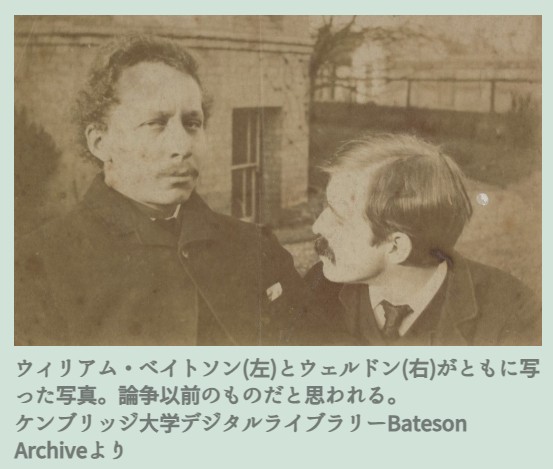
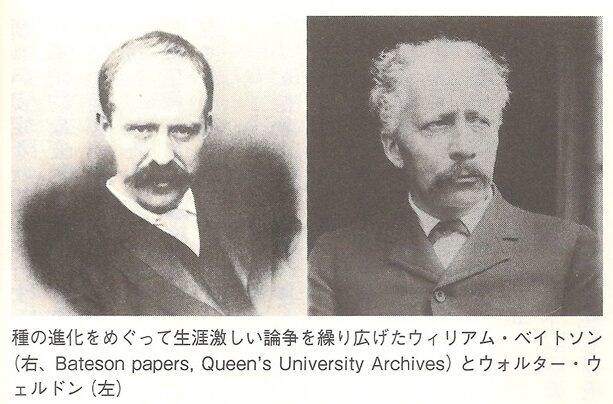
On the left is an image of The “Secret” Relationship between Motoo Kimura and Gregory Bateson. On the right is an image of Chiba’s Darwin’s Curse. Chiba even goes so far as to imitate the way they are introduced, with William Bateson and Weldon standing side by side. It’s kind of funny that they’ve switched their positions, though.
On the top is an image of The “Secret” Relationship between Motoo Kimura and Gregory Bateson. On the bottom is an image of Chiba’s Darwin’s Curse. Chiba even goes so far as to imitate the way they are introduced, with William Bateson and Weldon standing side by side. It’s kind of funny that they’ve switched their positions, though.
Furthermore, the structure is identical in every respect: both were influenced by Francis Galton; Weldon discovered dimorphism by measuring the carapace sizes of Mediterranean crabs; and Weldon began collaborating with Pearson.
It seems Chiba has plagiarized not only from my article The “Secret” Relationship between Motoo Kimura and Gregory Bateson but also from my other writings.
For example, in An Attempt to Organize Thinking Patterns Using Kobo-chan as an Example (1) Metaphor, I wrote the following:
In the first place, can the sender of information reliably limit the information to either its ‘as-is’ or ‘metaphorical’ meaning?
For example, symbolic information, such as Morse code, is sent out to expect it to be received and decoded as is. However, in the end, it all depends on the receiver. If the meaning decoded from the signal is incomprehensible or unintelligible to the receiver, they will think, “Is this a metaphorical meaning rather than a literal one?”
On the other hand, suppose the sender intentionally sends information that is literally incomprehensible because they want it to be taken figuratively. However, the receiver may stubbornly try to interpret the information in a literal sense.
In other words, information is almost inevitably multilayered, and the possibility of discrepancies occurring within those layers cannot be eliminated.
Meanwhile, Chiba writes as follows:
Communication between the sender and receiver of information, the receiver’s cognitive biases, and the processes of information transformation and reinterpretation bring about directional cultural change.
From Darwin’s Curse
It just looks like a rephrasing of something I wrote.
Chiba also writes the following:
Most people always wish to be righteous, good, and moral. However, it is known that the stronger one’s moral motivation becomes, the greater the aversion to being perceived by others as morally flawed. Consequently, a strong sense of morality gives rise to a dishonest mindset that refuses to acknowledge moral flaws or errors, thereby becoming immoral. Because of this phenomenon, known as the moral paradox, a strong sense of morality can lead to immoral outcomes.
From Darwin’s Curse
He also writes this:
I believe that there are universal concepts of good and evil for humanity, and that there are self-evident forms of both goodwill and malice. But to be good, all we can do is lay down the bricks of goodwill one by one, while praying that they are not evil. No matter how difficult it may be, I want to be good, and evil must be restrained by law. Yet at the same time, the chaos within each person’s heart—where good and evil, right and wrong, and contradictions intertwine—also strikes me as fascinating. If evil were to vanish from the world, we would never again be able to enjoy the exhilarating tales of heroes. What is truly important, I think, is that each person can have their own dreams—and that if the place where we lay a brick turns out to be wrong, we can correct that mistake.
From Darwin’s Curse
One thing is certain: if there is a person who talks about morality, right and wrong, or justice while stealing the work of others, that person is completely out of their mind. Plagiarism is clearly a crime. As Chiba himself wrote, “evil must be restrained by law,” the crime of plagiarism must therefore be restrained by law.
A response from Satoshi Chiba, who drove the snails endemic to Chichijima to extinction, and Kodansha, where the man who murdered his wife and committed perjury served as deputy editor-in-chief
After realizing that Chiba had plagiarized my work, I noticed a section titled ‘Report Copyright Infringement’ on the Kodansha website, so I sent an email with the following content.
[Inquiry Details] Tuesday, December 12, 2023, 1:11 AM
I have found passages in Satoshi Chiba’s new book, Darwin’s Curse, that appear to be plagiarized from my blog or that cite sources without proper attribution. On my website VESTIGIUM, in the post titled The “Secret” Relationship between Motoo Kimura and Gregory Bateson
(https://viesauvagevestigium.com/kimuramotoobateson/),
I wrote about William Bateson and Raphael Weldon, as well as their debate, which divided them into the Mendelian and biometric schools. However, Mr. Chiba has written about this using almost the same structure. The points he makes—namely, that the two were originally friends and were both influenced by Francis Galton—are the same.
I wrote the following about Gregory Bateson: “William Bateson, the winner of the controversy, named his third son after Mendel’s baptismal name, Gregor, who was born in 1904 during the debate. That son was Gregory Bateson.”
On the other hand, Mr. Chiba writes: “Incidentally, Bateson named his third son Gregory in honor of his revered Gregor Mendel; this third son is Gregory Bateson, the proponent of the double-bind theory and a giant in the fields of cultural anthropology, social sciences, and psychiatry.” It is clear that the phrasing is similar.
It seems clear that Mr. Chiba has used my blog as a reference and copied from it, yet this book lists only bibliographic references and does not include any website sources. However, The Mechanics of Evolution, another book by Mr. Chiba, published by the same publisher, Kodansha, does list website sources. Why did he not include website sources in Darwin’s Curse?
If appropriate action is not taken, I feel I will have no choice but to write an article about this matter and make it public. Since I maintain a blog in both Japanese and English, I naturally intend to publish an article in English as well.
I ask that you handle this matter with the utmost rigor.
I then received a reply with the following content.
Dear Mr. Nakamura,
Regarding your inquiry, the editorial department of Gendai Shinsho is writing to respond.
We have received a report that Darwin’s Curse contains passages and expressions borrowed from the blog you operate.
Upon checking with the author, we confirmed that the passages in question were written with reference to the sources listed below, and that the author had not read your blog.
【Regarding the dispute between the two factions】
Provine W 1971. The Origins of Theoretical Population Genetics. Univ. Chicago Press.
Farrall LA 1975. Controversy and conflict in science: A case study – The English Biometric School and Mendel’s Laws. Social Studies of Science 5:269-301.
Olby R 1989. The dimensions of scientific controversy: the biometric—Mendelian debate. Br J. Hist. Sci. 22:299-320.
【Regarding Gregory Bateson】
Lipset D 2005 Author and hero – Rereading Gregory Bateson: The legacy of a scientist. Anthropol. Quart. 78:899–914.
All of these are listed in the bibliography at the end of the book.
Therefore, the editorial department has determined that this does not constitute copyright infringement.
We appreciate your understanding.
Takatsuki, Modern Shinsho Editorial Department, Kodansha Academic Publishing Division I
Tuesday, December 12, 2023, 4:03 PM
That’s what they say.
First and foremost, it must be made clear that nothing said by Kodansha employees can be trusted. Let me list the major crimes committed by Kodansha employees in recent years.
May 20, 2002, Satoshi Ōtsubo (42), deputy editor-in-chief in charge of the photo spreads for Kodansha’s Weekly Shonen Magazine (resident of Meguro Ward, Tokyo), his wife Haruka (30), and Masahiko Kubo (36), another deputy editor-in-chief in charge of the photo spreads for Weekly Shonen Magazine, were arrested on suspicion of violating the Cannabis Control Act (possession).
July 7, 2010, Hideyuki Igarashi (48), a department head at Kodansha’s Third Editorial Bureau, was arrested on suspicion of assault for allegedly striking a female patron at a restaurant in Shinjuku Ward, Tokyo. (Kodansha Editor Arrested on Suspicion of Assault: Struck Customer at Tokyo Restaurant)
January 10, 2017, Park Jong-hyun (41), deputy editor-in-chief of the youth comic magazine Morning at Kodansha, was arrested on suspicion of murder for allegedly killing his wife (38) at their home in Bunkyo Ward, Tokyo, in August 2016.
Here, let’s take a closer look at the murder of his wife by Park Jong-hyun, the former deputy editor-in-chief of Kodansha. This is because Park committed perjury during the investigation into this case.
First, let’s quote an article reporting on this incident.
The hit editor behind The Seven Deadly Sins faces murder charges, drawing public attention.
In the early hours of August 9, 2016, Defendant Park called 911 from his home in Bunkyo Ward, Tokyo.
“My wife is lying on the floor.”
When paramedics arrived at the two-story house, they found his wife, Kanako (38 at the time), lying near the bottom of the stairs. She was already in cardiac arrest, and her death was confirmed at the hospital to which she was transported.
Defendant Park initially told emergency responders that “my wife fell down the stairs,” but the next day he changed his story, stating that “she committed suicide by hanging herself from the stair railing.” It is believed that Kanako’s cause of death was suffocation due to compression of the neck. The Metropolitan Police Department found his inconsistent statements and behavior suspicious and proceeded with the investigation.
“At the time, Kanako had recently given birth to her fourth child and was believed to have been suffering from postpartum depression. Shortly before her death, she had visited a family support center to complain that her husband wasn’t helping with childcare, and she had also reported domestic violence by the defendant Park.”
Taking these circumstances into account, the Metropolitan Police Department conducted a thorough investigation. As a result, urine from Kanako was found in the bedroom on the first floor, and saliva mixed with blood was detected, strengthening the suspicion that the defendant Park strangled her to death.
“Then, in January 2017—about four months after the incident—he was arrested on suspicion of murder. Based on other circumstantial evidence, the Metropolitan Police Department, in collaboration with the prosecution, constructed a narrative in which the defendant Park strangled Kanako on the first floor and then pushed her off the second floor to destroy evidence,” said the reporter mentioned earlier.
Park later filed an appeal, but it was dismissed by the Supreme Court, and he was sentenced to 11 years in prison.
Park is found guilty.
What must be emphasized is the fact that a man who strangled his wife to death, then falsely claimed she had fallen down the stairs, and later changed his testimony to say she had hanged herself from the banister, was the deputy editor-in-chief at Kodansha.
Furthermore, according to this reply from Kodansha, Chiba claims he has never even seen this blog.
Who in their right mind would believe the claims of the very person who, despite failing in pest control and driving the island’s endemic snails to extinction, wrote three books while concealing the fact that it was his own mistake—and which, publishing house whose deputy editor-in-chief after strangling his wife to death, falsely claimed she had fallen down the stairs or even hanged herself from the banister?
If authors can write books by stealing from others’ work, and when accused of plagiarism, simply reply, “I’ve never even read it,” and get away with it, then aren’t authors and publishers free to do whatever they please?
Personally, as I wrote in my email to Kodansha, I had thought that it would be enough if they simply took “strict disciplinary action.” However, there is no point in expecting “strict disciplinary action” from a publishing house where the deputy editor-in-chief is a man who strangled his wife to death and then committed perjury; their claims are virtually devoid of any credibility. Moreover, Chiba himself writes with conviction that “evil must be restrained by the law.”
I see. In that case, I need to consult with the investigative authority first and have them check the server logs to see if there are any records of access from Chiba or Kodansha employees. That is the first step necessary to fulfill Chiba’s own statement that “evil must be restrained by the law.”
National Police Agency Cyber Incident Consultation Desk
Agency for Cultural Affairs, Comprehensive Guide to Copyright Policies
Possibility of organized crime
As I wrote in Suspicion of Plagiarism Against Isao Sarashina, the problem isn’t limited to Chiba. Sarashina’s plagiarism also occurred through Kodansha. Incidentally, Sarashina stated the following in an interview:
――Are there any books you’d recommend reading alongside On the Origin of Species?
Sarashina: My top recommendation is The Book That Lets You Pretend You’ve Read On the Origin of Species (laughs), but there are other good books as well, so let me introduce a few.
First, Darwin’s Curse (Kodansha Gendai Shinsho) by Satoshi Chiba, who was also a senior of mine in graduate school. Next, How Accurate Is Darwin’s Theory of Evolution? (Kobunsha Shinsho) by Masakado Kawata, a former professor at Tohoku University. Both are part of the “Shinsho” series and are easy to read.
Since each offers a slightly different perspective, I think it would be interesting to read them together.
It is said that Chiba and Sarashina were senior and junior colleagues at the same graduate school. Here we have two people who were senior and junior colleagues in the same laboratory, both engaging in behavior that can only be described as plagiarism through the same publisher. If that is the case, couldn’t this be considered organized crime? It is entirely possible that it was not Chiba or Sarashina, but rather an editor at Kodansha who instigated the act by saying, “Let’s steal from this blog.”
Incidentally, I should add that the Japanese Copyright Act was amended in 2018, allowing investigative agencies to take action even without a complaint from the victim in serious cases such as organized infringement.
Since there is a strong possibility that we will be able to prove this constitutes systematic copyright infringement in the future, we should continue to monitor not only Satoshi Chiba and Isao Sarashina, but also Kodansha and those associated with it. However, the truth is that even without monitoring, there is a very high likelihood that in cases like this, those involved will inadvertently give themselves away and bring about their own downfall. That is simply the nature of corrupt organizations and their associates.
Kodansha announced on November 4, 2025, that it had established a Hollywood-based film production company. It is reported that the company will partner with Academy Award-winning director Chloe Zhao and producer Nicholas Gonda. (Kodansha opens a new studio in Hollywood. “To play a more proactive role in the global expansion of manga and novels.”)
At this point, it is essential to explain to them exactly what kind of company Kodansha is. If they work with Kodansha without knowing this, there is no guarantee they won’t later be drawn into crimes or troubles caused by Kodansha employees. In that sense, there is great value in writing this article in English as well.
Finally, let me share a truly thought-provoking passage by a certain “distinguished figure.”
I believe that there are universal concepts of good and evil for humanity, and that there are self-evident forms of both goodwill and malice. However, to be good, all we can do is lay down the bricks of goodwill one by one, while praying that they are not evil. No matter how difficult it may be, I wish to be good, and evil must be restrained by law.
2026.4.6
◯Reference website
About the Invasion of the New Guinea flatworm in the Ogasawara Islands and Measures for Its Control
Impacts of the invasive flatworm Platydemus manokwari on island-endemic land snails
Initiatives by Tokyo Metropolitan Government – Invasive alien species control
An Invader Threatening Ogasawara’s Snails: The Threat of the New Guinea flatworm
It is said that Park Jong-hyun’s crimes were “foretold” in several manga published by Kodansha itself.
https://x.com/onibuta/status/818836520903720961
http://blog.esuteru.com/archives/20007794.html
https://x.com/kiyo_2643/status/818675758709108736
https://twicomi.com/manga/skekiyo_sizma/1356119191472889858
There is even a manga that depicts the period between Park Jong-hyun’s murder of his wife and his arrest, during which Park himself served as the editor.
What I know
Just one week before this article was published, Kodansha had already suspended the distribution of its manga due to copyright infringement.
Monthly Shonen Magazine Apologizes for Ending Manga Adaptation Series: “We sincerely apologize”—Distribution Halted After Plagiarism of Other Works Discovered
※The content, text and images are prohibited to reproduce, quote or use in any way other than for correct quotation.